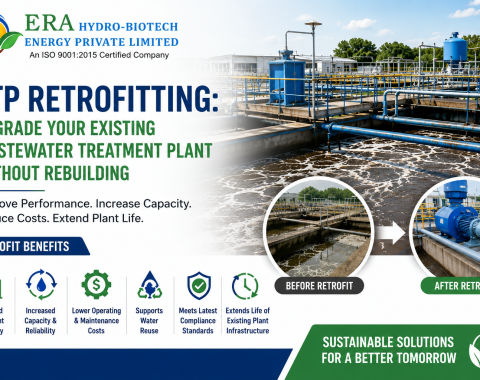
How Plant Upgradation Extends the Life of Aging Infrastructure
Your treatment plant worked fine ten years ago. Now it struggles. Effluent quality slips. Breakdowns happen more often. Compliance reports get harder to file on time. If this sounds familiar, you don’t need a brand-new plant. You need a wastewater treatment plant upgradation.
Plant upgradation takes your existing setup and brings it back to full strength. It’s faster than building new, it costs less, and it can add 10 to 15 more years of reliable service to a plant that’s already showing its age.
In this guide, we explain what plant upgradation actually involves, how it extends the life of an aging industrial effluent treatment plant, and how to know when it’s time to act.
Quick Answer: What Is Plant Upgradation?
Plant upgradation means you repair, replace, and modernise the parts of a wastewater treatment plant that no longer work well. Instead of tearing down an old plant and building a new one, you upgrade the equipment, process design, and control systems that are already in place.
This applies to:
- Effluent treatment plants (ETP)
- Sewage treatment plants (STP)
- Water treatment plants (WTP)
The goal stays the same across all three: bring an aging plant back to full performance, meet current compliance standards, and stretch its useful life by years, not months.
Why Do Treatment Plants Age So Fast?
Most industrial and municipal treatment plants run 24/7, under constant chemical and mechanical stress. A few common reasons plants wear out faster than expected:
- Corrosion — tanks, pipes, and pumps degrade from constant contact with effluent
- Outdated design — old plants often can’t handle today’s higher waste loads
- Equipment fatigue — pumps, blowers, and motors wear down after years of continuous run time
- Stricter norms — pollution control boards keep tightening discharge limits, and old plants can’t always keep up
- Poor past maintenance — skipped servicing speeds up wear on every part of the system
None of these problems mean the plant is beyond saving. They just mean it’s time for a proper upgrade.
Signs Your Wastewater Treatment Plant Needs Upgradation
Watch for these warning signs. They tell you the plant is losing capacity, not just having a bad week.
- Effluent quality fails to meet discharge norms more often than it used to
- Breakdowns happen more frequently, and repair costs keep climbing
- The plant can’t handle your current waste volume, let alone future growth
- Energy consumption keeps rising without any gain in output
- Pollution control board inspections flag repeat issues
- Operators spend more time firefighting than running the plant smoothly
If two or more of these sound familiar, get a professional plant audit before a small issue turns into a compliance shutdown.
How Plant Upgradation Extends the Life of Aging Infrastructure
Here’s exactly how an upgrade adds years back to your plant.
1. It Restores Lost Treatment Capacity
Old pumps, blowers, and aeration systems lose efficiency over time. Replacing worn components brings the plant back to its full rated capacity, sometimes higher than the original design.
2. It Fixes Structural Wear Before It Becomes a Failure
Corroded tanks, cracked chambers, and worn pipework don’t fix themselves. A proper upgrade repairs or replaces this structural damage early, before it causes a full system failure or a costly emergency shutdown.
3. It Brings the Plant Up to Current Compliance Standards
Discharge norms change. A plant designed 15 years ago may not meet today’s Pollution Control Board limits. Upgradation adds the treatment stages or automation needed to hit current standards, without building a whole new facility.
4. It Improves Energy Efficiency
Modern pumps, blowers, and control systems use far less power than older equipment. Upgrading these components cuts your energy bill while boosting output, a rare win-win in plant operations.
5. It Adds Smart Monitoring and Automation
Many aging plants still run on manual checks and guesswork. Adding sensors, automated dosing, and remote monitoring lets you catch problems early. This alone can add years to equipment life, since small issues get fixed before they turn into big ones.
6. It Expands Capacity for Future Growth
If your industrial output is growing, your treatment plant needs to grow with it. Upgradation can add treatment trains or expand tank capacity, so you don’t outgrow your plant again in five years.
Wastewater Treatment Plant Upgradation vs. Building New
This is the question every plant owner asks. Here’s a direct comparison.
| Factor | Plant Upgradation | New Plant Construction |
|---|---|---|
| Cost | Lower — you reuse existing infrastructure | Higher — full civil and mechanical build |
| Timeline | Weeks to a few months | Often 12+ months |
| Downtime | Can often be phased to avoid full shutdown | Requires full new commissioning |
| Compliance | Brings plant up to current norms | Meets norms from day one, but at a much higher cost |
| Best for | Plants with solid civil structure but aging equipment | Plants beyond structural repair, or major capacity jumps |
In most cases, if your civil structure (tanks, chambers, foundations) is still sound, upgradation is the smarter, faster, and cheaper route.
What Does an Industrial Effluent Treatment Plant Upgradation Include?
A full ETP upgradation project typically covers:
- Mechanical equipment replacement — pumps, blowers, aerators, and agitators
- Process redesign — improving flow paths, tank sizing, or treatment stages
- Instrumentation upgrades — sensors, flow meters, and automated dosing systems
- Civil repair — tank relining, corrosion repair, structural reinforcement
- Electrical and control panel modernisation — safer, more efficient control systems
- Sludge handling improvements — better dewatering and disposal systems
- Zero Liquid Discharge (ZLD) integration — for plants that need to move toward full water reuse
Want to understand ZLD specifically? Read our guide: Zero Liquid Discharge (ZLD): Cost, When You Need It & How It Works
Step-by-Step: How ERA Approaches a Plant Upgradation Project
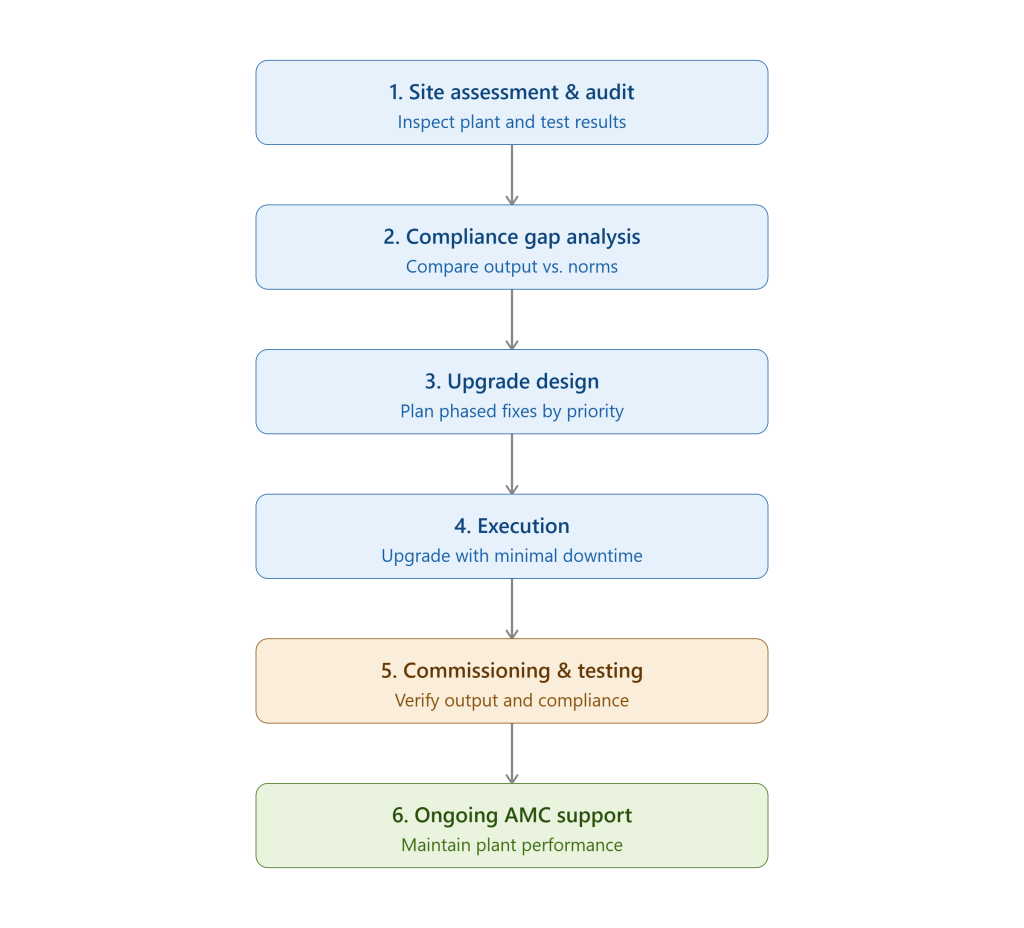
Step 1: Site Assessment & Plant Audit
We inspect your existing plant, review effluent test results, and check every major component. This tells us exactly what’s failing and what’s still working well.
Step 2: Gap Analysis Against Compliance Norms
We compare your current output against current Pollution Control Board and CPCB standards, so the upgrade design closes every compliance gap, not just the obvious ones.
Step 3: Upgrade Design & Proposal
We design a phased upgrade plan. This usually prioritises the most urgent fixes first, so you’re not stuck choosing between full downtime and partial compliance.
Step 4: Execution With Minimal Disruption
Wherever possible, we phase the work so your plant keeps running during the upgrade. Full shutdowns are the exception, not the rule.
Step 5: Commissioning & Performance Testing
Once the upgrade is complete, we test the plant against your required output and compliance standards before handover.
Step 6: Ongoing AMC Support
Post-upgrade, regular maintenance keeps your newly upgraded plant running at full strength for years. See our AMC & O&M services for ongoing support options.
Benefits of Timely Plant Upgradation
- Lower long-term costs — cheaper than emergency repairs or full rebuilds
- Fewer compliance penalties — stay ahead of Pollution Control Board action
- Longer equipment life — extend your plant’s working life by 10 to 15 years
- Better energy efficiency — modern equipment cuts power costs
- Higher treatment capacity — handle more waste without a new facility
- Reduced downtime risk — planned upgrades beat unplanned breakdowns every time
Who Needs This Service?
Plant upgradation makes sense for:
- Manufacturing plants with an ETP older than 10-12 years
- Industrial facilities facing new or stricter discharge norms
- Factories that have expanded production but not their treatment capacity
- Any site that failed a recent Pollution Control Board inspection
- Facilities planning a ZLD transition and needing existing infrastructure upgraded first
Why Choose ERA Hydro-Biotech for Your Plant Upgradation
ERA Hydro-Biotech Energy Pvt. Ltd. has designed, built, and upgraded water and wastewater systems since 2006. We understand aging infrastructure because we’ve worked on it for close to two decades, across ETPs, STPs, and WTPs of every size.
What sets our approach apart:
- Nearly 20 years of hands-on plant engineering experience in Maharashtra and across India
- A phased upgrade approach that keeps your plant running wherever possible
- Full-service support, from the first site audit to post-upgrade AMC
- Deep experience across ETP, STP, WTP, ZLD, and biogas systems, so we see your full utility picture, not just one plant in isolation
We’ve helped industrial clients bring failing plants back to full compliance and capacity, without the cost or downtime of a full rebuild. We can do the same for your facility.
Read more about our full retrofit approach here: Retrofit & Augmentation Solutions
Frequently Asked Questions
What is wastewater treatment plant upgradation?
Plant upgradation means repairing, replacing, and modernising the equipment and design of an existing wastewater treatment plant, instead of building a brand-new plant.
How long does an industrial effluent treatment plant upgradation take?
Most upgrade projects take a few weeks to a few months, depending on plant size and scope of work. This is far shorter than building a new plant from scratch.
How much does plant upgradation cost compared to a new plant?
Upgradation usually costs significantly less than new construction, since you reuse existing civil structure and only replace equipment that has failed or become outdated.
Can a plant run during the upgradation process?
In most cases, yes. A phased upgrade plan lets a facility keep operating with minimal disruption, though some short shutdowns may be needed for specific stages.
How do I know if my plant needs upgradation instead of a full rebuild?
If your tanks and civil structure are still structurally sound, and it’s mainly equipment, automation, or capacity that’s failing, upgradation is usually the right call. A professional site audit gives you a clear answer.
Does plant upgradation help with new pollution control norms?
Yes. Upgradation can add treatment stages, automation, and monitoring needed to meet current discharge standards, without a full plant replacement.
Ready to Extend the Life of Your Treatment Plant?
Don’t wait for a compliance notice or a breakdown to force your hand. A wastewater treatment plant upgradation from ERA Hydro-Biotech can add years of reliable service back to your facility, at a fraction of the cost of building new.
Request a free plant audit and find out exactly what your plant needs.
Want to explore our full range of treatment solutions first? Check out our Effluent Treatment Plants (ETP) page, or contact our team directly to discuss your plant’s condition.