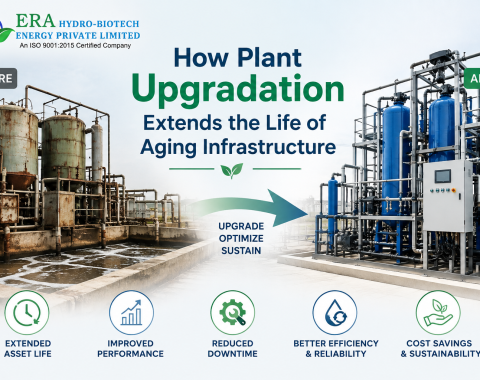
Many industries already have an Effluent Treatment Plant (ETP), but an old or underperforming plant may no longer meet current production, wastewater, or treatment needs. The good news is that you do not always need to build a completely new ETP.
With the right assessment and engineering plan, industries can upgrade an existing system through ETP retrofitting, plant augmentation, process modification, equipment replacement, automation, and water recycling.
This approach can improve treatment performance, increase capacity, reduce operating problems, and extend the useful life of existing infrastructure.
In this guide, we explain how retrofit wastewater treatment works, when your ETP needs an upgrade, which components you can retrofit, and how to plan an ETP modernization project.
What Is ETP Retrofitting?
ETP retrofitting means upgrading or modifying an existing Effluent Treatment Plant instead of completely replacing it.
During a retrofit project, an engineering team first studies the existing plant, wastewater characteristics, equipment condition, treatment performance, and future requirements. Based on this assessment, the team modifies selected treatment units or adds new processes.
A retrofit wastewater treatment project may include:
- Replacing old pumps and blowers
- Improving aeration systems
- Upgrading biological treatment
- Adding filtration or membrane systems
- Increasing treatment capacity
- Improving sludge handling
- Installing automation and monitoring systems
- Modifying tanks or piping
- Adding water recycling systems
- Integrating advanced treatment processes
The exact solution depends on the condition and design of the existing ETP.
Why Do Existing ETP Plants Need Retrofitting?
An ETP that worked well several years ago may not perform the same way today.
Industrial production can increase, wastewater characteristics can change, and treatment requirements can become more demanding. At the same time, old mechanical and electrical equipment can lose efficiency.
Common reasons for ETP upgradation include:
1. Increased Wastewater Flow
Your production may have expanded, but your ETP capacity may remain the same.
For example, an ETP originally designed for 500 KLD may struggle when wastewater generation increases significantly.
Retrofitting can help increase capacity without replacing every existing structure.
2. Poor Treated-Water Quality
If the existing plant consistently struggles with parameters such as BOD, COD, TSS, oil and grease, or other industry-specific pollutants, the treatment process may need modification.
A process audit can identify where the treatment system loses efficiency.
3. Changes in Industrial Wastewater
Manufacturing processes can change over time.
A factory may introduce new raw materials, chemicals, production lines, or processes. These changes can alter the wastewater characteristics.
The existing ETP may then require additional treatment stages.
4. Aging Equipment
Pumps, blowers, mixers, control panels, membranes, valves, and other components have a limited operating life.
Replacing inefficient equipment can improve plant reliability and reduce breakdowns.
5. Higher Water-Reuse Requirements
Many industries now want to recover and reuse more treated wastewater.
An existing ETP may require additional filtration, membrane treatment, RO, or other polishing processes to support suitable reuse applications.
6. Compliance Requirements
Industries must operate their wastewater treatment systems according to applicable environmental requirements and consent conditions.
If an existing plant cannot consistently achieve the required treated-water quality, an upgrade may become necessary.
Can You Retrofit an ETP Without Rebuilding It?
Yes. In many cases, industries can retrofit an existing ETP without completely rebuilding the plant.
However, the feasibility depends on the existing civil structures, equipment condition, hydraulic profile, available space, wastewater characteristics, treatment process, and future capacity requirements.
A professional assessment should come before deciding whether to retrofit or replace the plant.
In some cases, engineers can reuse:
- Existing treatment tanks
- Equalization tanks
- Clarifiers
- Structural foundations
- Piping networks
- Electrical infrastructure
- Sludge-handling areas
The project team can then modify or add the components that require improvement.
This can reduce unnecessary construction and help the plant return to operation faster.
How Does Retrofit Wastewater Treatment Work?
A successful retrofit project usually follows a structured process.
Step 1: Inspect the Existing ETP
The first step involves a detailed inspection of the existing treatment plant.
The assessment should cover:
- Existing plant capacity
- Actual wastewater flow
- Wastewater characteristics
- Treatment process
- Tank dimensions
- Equipment condition
- Electrical systems
- Piping and hydraulics
- Sludge generation
- Operating problems
- Maintenance history
- Available space
This assessment helps identify the real cause of poor performance.
Step 2: Test the Wastewater
Wastewater testing plays a key role in retrofit design.
Depending on the industry, engineers may review parameters such as:
- pH
- BOD
- COD
- TSS
- TDS
- Oil and grease
- Chlorides
- Sulphates
- Heavy metals
- Temperature
- Industry-specific pollutants
The treatment process should match the actual wastewater load.
Step 3: Identify the Performance Gap
Next, compare the existing ETP’s performance with the current requirement.
For example:
Existing capacity: 500 KLD
Current wastewater generation: 700 KLD
Problem: Hydraulic overload
Or:
Existing process: Biological treatment
New requirement: Higher water-reuse quality
Solution: Add tertiary treatment and water-recovery stages
This gap analysis helps define the retrofit scope.
Step 4: Select the Right Retrofit Technology
The engineering team can then recommend suitable modifications.
Depending on the problem, the retrofit may include:
- Additional equalization capacity
- Improved aeration
- MBBR media
- SBR modifications
- MBR integration
- Chemical dosing systems
- Advanced clarification
- Pressure sand filters
- Activated carbon filters
- UF systems
- RO systems
- Sludge dewatering
- Automation and instrumentation
The goal should not be to add technology unnecessarily. The goal is to solve the actual treatment problem with the most practical solution.
Step 5: Modify Existing Equipment and Structures
The project team can reuse suitable infrastructure and replace components that no longer meet performance requirements.
This can include:
- Pump replacement
- Blower upgrades
- Diffuser replacement
- Media installation
- Piping modifications
- Tank modifications
- Electrical panel upgrades
- Instrumentation
- Automation
- Sludge-system improvements
Step 6: Commission and Test the Upgraded Plant
After installation, the upgraded system needs proper commissioning.
The team should check:
- Flow distribution
- Equipment performance
- Aeration
- Chemical dosing
- Biological treatment
- Filtration
- Sludge handling
- Treated-water quality
- Automation
- Safety systems
Operators should also receive proper training before regular operation begins.
Which ETP Components Can Be Retrofitted?
Almost every major section of an ETP can potentially be reviewed for upgradation.
Equalization System
Engineers can improve mixing, pumping, aeration, and flow control to manage variable wastewater loads.
Biological Treatment
Existing biological systems can sometimes receive additional media, improved aeration, or process modifications to increase treatment efficiency.
Clarification
An inefficient clarifier may require hydraulic improvements, mechanical upgrades, or process changes.
Aeration System
Old blowers and diffusers can consume excessive energy.
Modern aeration equipment can improve oxygen transfer and help reduce unnecessary power consumption.
Filtration System
Additional filtration can improve treated-water quality and prepare the water for reuse or membrane treatment.
Sludge Management
Improved sludge thickening and dewatering can simplify handling and reduce disposal challenges.
Automation
Sensors, control panels, flow meters, online monitoring, and automation can improve process control and help operators identify problems earlier.
Benefits of ETP Retrofitting
A well-planned retrofit wastewater treatment project can offer several benefits.
1. Avoid Complete Plant Replacement
You may be able to reuse suitable existing infrastructure instead of starting from zero.
2. Increase Treatment Capacity
Plant augmentation can help an existing ETP handle higher wastewater flows.
3. Improve Treatment Performance
Process upgrades can help improve treated-water quality when the existing process has performance limitations.
4. Reduce Equipment Downtime
Replacing unreliable components can improve plant availability.
5. Support Water Recycling
Additional treatment stages can help industries recover more treated water for suitable reuse applications.
6. Extend Plant Life
Regular upgrades and timely replacement of aging equipment can extend the useful life of an existing treatment system.
7. Improve Energy Efficiency
Upgrading inefficient pumps, blowers, aeration systems, and controls can help reduce unnecessary energy consumption.
8. Reduce Long-Term Costs
Retrofitting can be more practical than replacing an entire plant when the existing civil infrastructure remains suitable.
ETP Retrofitting vs New ETP: Which Is Better?
The answer depends on the condition of the existing plant.
| Factor | ETP Retrofitting | New ETP |
|---|---|---|
| Existing structure | Can reuse suitable structures | New construction |
| Construction work | Usually lower | Usually higher |
| Plant downtime | Can be planned in phases | Required during installation |
| Capacity expansion | Possible | Easier for major expansion |
| Existing equipment | Reuse selected equipment | New equipment |
| Project flexibility | Depends on existing layout | Higher |
| Best suited for | Upgrade/modernization | Major replacement or new facility |
Retrofitting works best when the existing plant has usable infrastructure and only selected components or processes need improvement.
A completely new ETP may make more sense when the existing structure has severe damage, the treatment process is fundamentally unsuitable, or the required capacity has increased substantially.
How Much Does ETP Retrofitting Cost?
There is no standard retrofit wastewater treatment cost because every existing plant has different requirements.
The final cost depends on:
- ETP capacity
- Existing civil condition
- Wastewater characteristics
- Required treatment quality
- Equipment condition
- Required capacity increase
- Automation level
- Filtration requirements
- Membrane requirements
- Sludge-management requirements
- Installation and commissioning work
Therefore, industries should request a site assessment and retrofit proposal rather than relying on a standard price per KLD.
How to Know If Your ETP Needs Retrofitting
Your ETP may need an assessment if you notice:
- Frequent equipment breakdowns
- Poor treated-water quality
- Increasing operating costs
- Excessive sludge generation
- Strong odor problems
- Insufficient treatment capacity
- Frequent process upsets
- High power consumption
- Increasing wastewater generation
- Difficulty meeting required treatment standards
- Increased demand for treated-water reuse
If several of these problems occur together, a professional ETP audit can help identify whether retrofitting is the right solution.
Best Practices for a Successful ETP Retrofit
Before starting an ETP modernization project, follow these steps:
Conduct a complete plant audit
Do not replace equipment based only on age. First identify the actual performance problem.
Test current wastewater
Use recent wastewater data to design the retrofit.
Check civil structures
Existing tanks may look usable but require structural and hydraulic checks before reuse.
Plan shutdowns carefully
Industries often cannot stop production for long periods. Plan retrofit activities in phases wherever practical.
Consider future expansion
Do not design only for today’s wastewater flow. Consider realistic future production requirements.
Focus on lifecycle cost
Compare energy, chemicals, maintenance, sludge, and replacement costs—not only the initial retrofit investment.
Train operators
Even a well-designed plant can underperform without proper operation and maintenance.
Why Choose ERA Hydro-Biotech Energy for ETP Retrofitting?
ERA Hydro-Biotech Energy provides water and wastewater treatment solutions for industrial, commercial, institutional, and infrastructure projects across India.
The company has operated in the water and environmental engineering sector since 2006 and provides design, manufacturing, installation, retrofit, plant upgradation, and AMC support. Its current website highlights 20+ years of experience, 650+ installations, and ISO 9001:2015 certification.
ERA Hydro-Biotech’s retrofit and plant-upgradation services focus on improving ageing or underperforming STP, ETP, and WTP systems. The company also provides water recycling, ETP, WTP, and AMC solutions.
Why clients can consider ERA Hydro-Biotech:
- Customized retrofit solutions
- Plant performance assessment
- ETP capacity augmentation
- Process modernization
- Equipment replacement
- Water recycling solutions
- Installation and commissioning
- AMC and O&M support
- Compliance-focused engineering
- End-to-end project support
The company states that it serves clients across India and focuses on engineering solutions that improve efficiency, water reuse, and regulatory compliance.
Frequently Asked Questions
What is retrofit wastewater treatment?
Retrofit wastewater treatment means modifying or upgrading an existing wastewater treatment plant to improve its capacity, efficiency, reliability, treatment performance, or water-reuse capability without replacing the entire plant.
Can an old ETP be upgraded?
Yes. Engineers can often upgrade an old ETP by replacing outdated equipment, improving biological treatment, adding filtration, modifying hydraulics, increasing capacity, or installing automation. The existing civil structures must first pass a proper assessment.
Is ETP retrofitting cheaper than building a new plant?
It can be more cost-effective when the existing tanks, structures, and other infrastructure remain suitable for reuse. However, the actual cost depends on the plant’s condition and the required upgrades.
How long does ETP retrofitting take?
The timeline depends on the ETP capacity, retrofit scope, equipment availability, civil modifications, and commissioning requirements. A detailed site assessment can provide a more accurate project schedule.
Can retrofitting increase ETP capacity?
Yes. ETP capacity augmentation can increase treatment capacity when the existing hydraulic and process conditions allow it. Engineers need to check tank volumes, loading rates, equipment capacity, and hydraulic limitations before recommending an expansion.
Can an existing ETP be upgraded for water reuse?
Yes. Industries can add suitable tertiary treatment, filtration, membrane systems, or other polishing processes to support specific water-reuse applications. The required process depends on the intended reuse and water-quality target.
When should an industry replace an ETP instead of retrofitting it?
Replacement may make more sense when the existing civil structures are severely damaged, the current process cannot meet the required treatment objective, the plant has major hydraulic limitations, or the required expansion is too large for practical retrofit work.
Conclusion
An ageing ETP does not automatically mean that you need a completely new wastewater treatment plant.
A properly planned retrofit wastewater treatment project can upgrade selected equipment, improve treatment processes, increase capacity, support water reuse, and extend the life of existing infrastructure.
The first step is a detailed ETP performance and condition assessment. From there, engineers can determine whether your plant needs equipment replacement, process modification, capacity augmentation, advanced treatment, automation, or a complete replacement.
If your existing ETP is struggling with capacity, treated-water quality, energy consumption, equipment breakdowns, or water-reuse requirements, consider an expert retrofit assessment before investing in a new plant.
Need to upgrade an existing ETP? Contact ERA Hydro-Biotech Energy for a customized plant assessment, retrofit, augmentation, and wastewater treatment solution.
Explore ERA Hydro-Biotech’s ETP & ZLD Solutions
Explore AMC & Plant Operations Support