RO Treatment Plant Guide: How Reverse Osmosis Solves Industrial and Drinking Water Problems in 2026
Do you get white spots on your utensils? Does your factory equipment scale up fast? Or does your drinking water just taste off? Chances are, your water has too many dissolved salts and minerals in it. That’s called high TDS (Total Dissolved Solids), and it’s one of the most common water problems across India.
Normal filters can’t fix this. You need reverse osmosis, or RO, to pull those dissolved solids out at a molecular level.
In this guide, we explain what RO technology actually does, how an RO treatment plant works, and who really needs one. Whether you run a factory or manage a housing project, this guide helps you make a smart, informed decision. As a trusted water treatment plant company, ERA Hydro-Biotech Energy designs and builds RO systems for both industrial and drinking water needs. Here’s everything you should know before you invest.
Why Regular Filtration Isn’t Enough Anymore
Basic filters catch dust, sand, and visible particles. But they can’t remove dissolved salts, heavy metals, or microscopic contaminants. And in many parts of India, groundwater and municipal supply carry high TDS levels, sometimes well above safe drinking limits.
This creates real problems:
- Bad taste and odor in drinking water
- Scaling in pipes, boilers, and industrial equipment
- Reduced machine life in manufacturing units
- Health risks from excess salts, fluoride, or heavy metals
This is exactly where RO technology steps in. It doesn’t just filter water. It purifies it at a much deeper level.
What Is RO (Reverse Osmosis) Technology?
Reverse osmosis is a purification process that pushes water through a very fine membrane. This membrane blocks dissolved salts, bacteria, and other impurities, while letting clean water pass through.
Think of it like a super-fine strainer, but at a molecular scale. Nothing except pure water molecules can get through easily.
Why Is It Called “Reverse” Osmosis?
In nature, water moves from a low-salt area to a high-salt area, that’s regular osmosis. RO technology reverses this. It applies pressure to push water the opposite way, forcing it through the membrane and leaving the salts and contaminants behind.
This simple idea makes RO one of the most reliable ways to treat both industrial water treatment plant needs and everyday drinking water.
How Does an RO Treatment Plant Work?
An RO plant doesn’t rely on just one step. It runs water through several treatment stages to get the best results.
1. Pre-Treatment
Raw water first passes through sediment and carbon filters. This step removes dust, chlorine, and larger particles that could damage the RO membrane.
2. RO Membrane Filtration
Here’s the core step. Water gets pushed through the semi-permeable membrane under pressure. Dissolved salts, heavy metals, bacteria, and other impurities get separated out as reject water.
3. Post-Treatment
The purified water often passes through a final polishing stage, like UV disinfection or mineral addition, to make it safe and pleasant to drink or use.
4. Storage and Distribution
Treated water then moves to storage tanks, ready for use, whether that’s a factory process line or a drinking water tap.
This is the same basic process used in both a small household RO unit and a large drinking water processing plant for a whole community or industry.
Types of RO Plants: Which One Do You Need?
Not all RO systems are the same size or purpose. Here’s a quick breakdown.
- Domestic RO systems – Small units for homes, apartments, and small offices. Handle basic drinking water needs.
- Commercial RO plants – Mid-size systems for hotels, hospitals, schools, and office buildings.
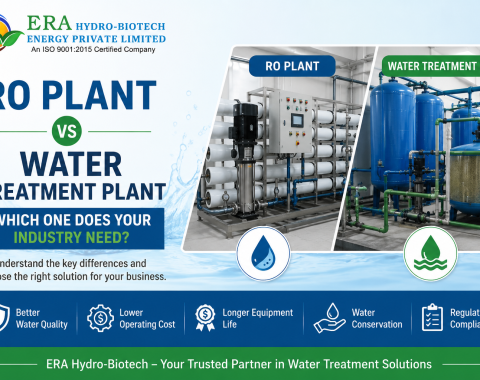
- Industrial RO plants – Large-capacity systems built for manufacturing units, power plants, and process industries. Often designed as part of a bigger water treatment plant setup.
- RO as part of ZLD systems – In many industries, RO plants work alongside Zero Liquid Discharge (ZLD) systems, recovering and reusing almost all the water on site.
Which Industries Actually Need an RO Plant?
RO technology isn’t just for drinking water. Many industries depend on it every day.
- Pharmaceutical companies – Need ultra-pure water for manufacturing and lab use
- Food and beverage units – Require consistent, safe water quality for production
- Textile industries – Use RO to treat process water and reduce mineral buildup in dyeing units
- Power plants – Rely on RO for boiler feed water to prevent scaling and equipment damage
- Municipal and community projects – Use large-scale RO plants to supply clean drinking water to residents
If your business handles sensitive processes, strict quality standards, or high-TDS source water, an industrial RO plant isn’t optional. It’s essential.
RO vs Other Water Purification Methods
Still comparing your options? Here’s how RO stacks up against other common methods.
| Method | What It Removes | Best For | Limitation |
|---|---|---|---|
| RO (Reverse Osmosis) | Dissolved salts, heavy metals, bacteria, most contaminants | High-TDS water, industrial and drinking water | Generates some reject water |
| UF (Ultrafiltration) | Bacteria, larger particles, some pathogens | Water with low TDS but microbial concerns | Can’t remove dissolved salts |
| Conventional Filtration | Sand, dust, visible particles | Basic pre-treatment only | Doesn’t touch dissolved impurities |
| Distillation | Almost everything, through evaporation | Lab-grade or specialty applications | High energy cost, slow process |
Simple takeaway: if your water has high TDS or dissolved contaminants, RO is usually the most practical and reliable choice for both homes and industries.
How to Choose the Right RO Plant Capacity
Picking the right size matters. Too small, and it can’t keep up. Too big, and you waste money.
Here’s what to check before you buy:
- Test your source water’s TDS level – This tells you how much treatment your water actually needs.
- Calculate your daily water requirement – Factories and large buildings need higher capacity plants than homes or small offices.
- Check your reject water ratio – A good RO plant should recover as much usable water as possible and waste as little as it can.
- Plan for future growth – If you’re expanding your facility, size your plant with some extra capacity built in.
- Get a professional water audit – A qualified water treatment plant company can test your water and recommend the exact system you need, so you don’t overpay or underbuy.
Signs Your Water Needs RO Treatment
Not sure if RO is right for you? Watch for these signs:
- White scale buildup on taps, utensils, or machinery
- Salty, bitter, or metallic taste in drinking water
- Frequent equipment breakdowns due to scaling
- Failed water quality tests for TDS or hardness
- Health complaints linked to water quality in your area
If any of this sounds familiar, it’s time to get your water tested.
How ERA Hydro-Biotech Energy Helps With RO and Water Treatment
At ERA Hydro-Biotech Energy, we design and build complete water treatment systems, not just RO units. As an experienced water treatment plant company, we work with both industries and communities to deliver clean, reliable water.
Here’s what makes our approach different:
- Custom-engineered systems – We size and design every RO plant around your actual water quality and daily demand.
- End-to-end project support – From water testing and design to installation, commissioning, and ongoing maintenance.
- Integration with ETP and ZLD systems – For industries that need full water recovery and reuse, not just purification.
- Proven field experience – We’ve delivered RO and water treatment projects for manufacturing units, commercial buildings, and residential communities across India.
We recently helped an industrial client cut their fresh water intake significantly by installing an RO system integrated with water recovery, lowering both their water bill and their environmental footprint. That’s the kind of practical, real-world result we aim for on every project.
Frequently Asked Questions
What is the cost of an RO treatment plant in India?
Cost depends on capacity, source water quality, and automation level. Small domestic units are affordable, while industrial RO plants can range from a few lakhs to much higher, based on daily output. Get a free water test and quote for an accurate estimate.
How much water does an RO plant waste?
RO systems do generate some reject water during the purification process. A well-designed plant keeps this to a minimum and can even recover and reuse the reject water in many industrial setups.
Is RO water safe for drinking every day?
Yes, RO water is safe and widely used for daily drinking. Good RO systems also include a mineral addition stage after filtration, so the water stays healthy and doesn’t taste flat.
What is the difference between RO and ZLD?
RO purifies water by removing dissolved salts and contaminants. ZLD (Zero Liquid Discharge) goes a step further and ensures no wastewater leaves the site at all, often using RO as one part of a larger treatment and recovery process.
How long does an RO plant installation take?
For domestic and commercial units, installation usually takes a few days. Large industrial RO plants can take a few weeks to a few months, depending on capacity and site readiness.
Ready to Fix Your Water Quality Problem?
Whether you need a drinking water processing plant for your community or a full-scale industrial water treatment plant for your facility, ERA Hydro-Biotech Energy can guide you from water testing to final installation.
Talk to our team today. Get a clear, honest recommendation based on your actual water quality and usage needs.
Explore Our Water Treatment Plant Solutions