ETP vs STP — Which Wastewater Treatment Plant Does Your Industry Need in 2026
Do you run a factory? Or do you manage a housing society, hospital, or hotel? Then someone has probably asked you this question already: do you need an ETP or an STP?
It’s a fair question, and it confuses a lot of people. Both plants clean dirty water. Both use pipes, tanks, and pumps. But they don’t do the same job, and picking the wrong one can cost you time, money, and a compliance notice.
In this guide, we break it down in plain language. You’ll learn what each plant does, how they differ, and how to pick the right one for your site in 2026. As one of the trusted effluent treatment plant manufacturers in India, ERA Hydro-Biotech Energy has helped both factories and residential projects make this exact decision. Here’s what we tell every client.
Why Wastewater Treatment Isn’t Optional Anymore
Let’s start with the basics. Every industry, every housing complex, and every commercial building in India generates wastewater. And by law, you can’t just let it flow into a drain or a river.
The Central Pollution Control Board (CPCB) and state pollution control boards set strict discharge norms. If your site produces wastewater above a certain limit, and most do, you need a treatment plant. No exceptions.
Skip this step, and you risk:
- Notices and fines from your local pollution control board
- Delayed or cancelled project approvals
- Plant shutdowns during inspections
- Damage to soil, groundwater, and public health
So the real question isn’t “do I need treatment.” It’s “which plant do I need.” That’s where ETP and STP come in.
What Is an ETP? (Effluent Treatment Plant)
An ETP, or Effluent Treatment Plant, treats wastewater that comes from industrial processes. Think factories, manufacturing units, and chemical plants.
What Makes Industrial Effluent Different?
Industrial wastewater often carries:
- Heavy metals
- Oils and grease
- Dyes and pigments
- Acids, alkalis, and solvents
- High chemical oxygen demand (COD) and biological oxygen demand (BOD)
This waste needs stronger, multi-stage treatment before it’s safe to release.
How an Industrial Effluent Treatment Plant Works
A typical ETP process runs through these stages:
- Screening – removes large solids and debris
- Primary treatment – settles out oil, grease, and suspended solids
- Secondary treatment – uses biological methods to break down organic waste
- Tertiary/advanced treatment – removes remaining chemicals, color, and odor (often includes ZLD for zero liquid discharge)
Which Industries Need an ETP?
- Textile and dyeing units
- Pharmaceutical manufacturers
- Chemical and petrochemical plants
- Food and beverage processing units
- Automobile and metal finishing industries
If your business falls in any of these categories, you likely need an industrial effluent treatment plant, not a standard sewage system.
What Is an STP? (Sewage Treatment Plant)
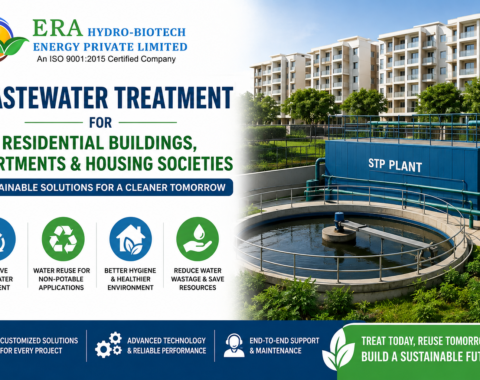
An STP, or Sewage Treatment Plant, treats domestic wastewater. This means water from toilets, kitchens, bathrooms, and laundry.
Where Does Domestic Sewage Come From?
- Residential apartments and housing societies
- Hotels and hostels
- Hospitals and clinics
- Offices, malls, and schools
How a Domestic Sewage Treatment Plant Works
STPs mostly deal with organic waste and pathogens, not heavy chemicals. The process is simpler:
- Screening and grit removal – filters out solids
- Primary settling – separates sludge from water
- Biological treatment – breaks down organic matter using bacteria (common tech: MBBR, SBR, or extended aeration)
- Disinfection – kills harmful pathogens before discharge or reuse
Where Is Treated STP Water Used?
Many buildings now reuse treated STP water for:
- Gardening and landscaping
- Flushing systems
- Cooling towers
- Construction activities
This cuts your fresh water use and your water bill too.
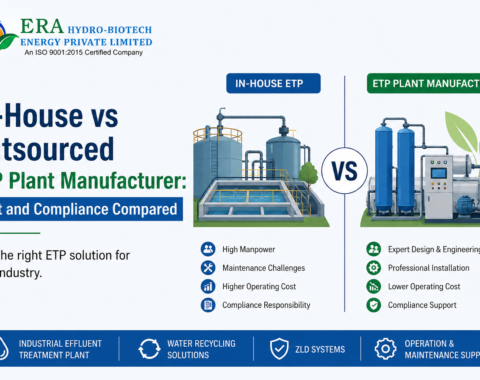
ETP vs STP: Side-by-Side Comparison
Still not sure which one applies to you? Here’s a clear comparison table.
| Parameter | ETP (Effluent Treatment Plant) | STP (Sewage Treatment Plant) |
|---|---|---|
| Source of Wastewater | Industrial effluent (factories, plants) | Domestic sewage (homes, hospitals, hotels) |
| Typical Industries | Pharma, textile, chemical, automobile | Housing societies, hospitals, hotels, offices |
| Treatment Complexity | High (chemical-heavy, multi-stage) | Medium (mostly biological treatment) |
| PCB Requirement | Mandatory for listed industries under CPCB/state PCB norms | Mandatory for buildings above a set capacity (usually 20 KLD or more) |
| Cost Range | ₹5 lakh–₹50 lakh+ (depends on capacity and technology) | ₹3 lakh–₹30 lakh+ (depends on capacity and reuse needs) |
| ERA Hydro-Biotech Solution | Custom-engineered ETP design, including ZLD systems | Packaged and custom STP solutions for residential and commercial sites |
Quick tip: if your wastewater comes from a manufacturing process, you need an ETP. If it comes from people using toilets and kitchens, you need an STP. Some large campuses, like industrial townships or hospital-cum-manufacturing sites, actually need both.
How to Decide Which One You Need
Not sure yet? Ask yourself these questions:
- What’s the source of your wastewater? Factory floor waste needs an ETP. Restroom and kitchen waste needs an STP.
- What’s your daily discharge volume? Higher volumes usually mean stricter compliance requirements and bigger plant capacity.
- Does your state pollution board require a specific consent category? Your CTE (Consent to Establish) and CTO (Consent to Operate) application will usually specify which plant type applies to your site.
- Do you want to reuse treated water? STP water reuse is common for irrigation and flushing. ETP water reuse often needs ZLD systems for full recycling.
- Are you running a mixed-use site? Some industrial campuses with on-site staff housing or canteens may need both an ETP and an STP working together.
Still unsure? A quick site assessment from an experienced ETP plant manufacturer in India clears this up fast, and saves you from installing the wrong system.
How ERA Hydro-Biotech Energy Helps With Both ETP and STP
At ERA Hydro-Biotech Energy, we don’t just sell equipment. We design, manufacture, install, and support both industrial effluent treatment plant and domestic sewage treatment plant systems, tailored to your site.
Here’s what sets our approach apart:
- Custom design, not one-size-fits-all – Every plant is engineered around your actual wastewater load and site conditions.
- Full regulatory support – We help you navigate CPCB and state PCB compliance, from consent applications to audits.
- Proven technology options – MBBR, SBR, MBR, and ZLD systems, matched to your industry and budget.
- End-to-end service – From site assessment and design to installation, commissioning, and ongoing O&M support.
We’ve worked with textile units, pharma companies, housing societies, and hospitality projects across India. Whether you need a single STP for your residential complex or a full ZLD-integrated ETP for your manufacturing plant, our team brings hands-on field experience to every project.
Explore our ETP and ZLD solutions as an ETP plant manufacturer in India.
Check our STP manufacturers in India solutions for residential and commercial sewage treatment.
Frequently Asked Questions
What is the main difference between ETP and STP?
An ETP treats industrial wastewater from factories and manufacturing units. An STP treats domestic sewage from toilets, kitchens, and bathrooms. The waste type, treatment stages, and compliance rules differ for each.
Can one plant handle both industrial and domestic wastewater?
Sometimes, yes, but it needs careful engineering. Combining both waste streams without proper design can overload the biological treatment stage and reduce plant efficiency.
Is STP mandatory for residential buildings in India?
Yes, in most states. Buildings that generate sewage above a set limit, commonly 20 KLD (kilolitres per day), need an STP and PCB approval before occupancy.
How much does an ETP or STP cost to install in India?
Costs vary widely based on capacity, technology, and site conditions. Small domestic STPs can start around ₹3 lakh, while industrial ETPs with ZLD can run into ₹50 lakh or more. Get a free site assessment for an accurate quote.
Which one should a hospital install, ETP or STP?
Most hospitals need an STP for general sewage, but if the facility handles lab chemicals or biomedical waste streams, it may also need effluent treatment for specific waste categories. A site-specific assessment is the safest way to confirm this.
Ready to Choose the Right Plant for Your Site?
You don’t have to figure this out alone. Whether you need an industrial effluent treatment plant, a domestic sewage treatment plant, or both, ERA Hydro-Biotech Energy can guide you through design, compliance, and installation from start to finish.
Talk to our team today. Get a clear recommendation based on your actual site, waste type, and budget, no guesswork involved.