Effluent Treatment Plant Consultant Guide: How to Choose the Right ETP Solution for Domestic and Industrial Wastewater
Do you run a factory, a housing society, or a commercial building? Then you already know one thing. Wastewater is not optional to treat. It’s the law. And it’s also good for your business, your land, and your community.
But here’s the problem. Not every wastewater is the same. A hostel’s sewage is not like a textile mill’s chemical waste. This is where the right effluent treatment plant consultant makes all the difference.
In this guide, we break down everything you need to know. We’ll cover what an ETP consultant does, how domestic and industrial wastewater treatment differ, and how to pick the right ETP water treatment plant for your site. No jargon. Just clear, useful answers.
Why One ETP Design Doesn’t Fit Every Site
Think of wastewater like food. A kid’s lunch and a factory canteen’s leftovers don’t need the same disposal method. Same logic applies here.
Domestic and industrial wastewater treatment needs differ because of:
- Contaminant load – Industrial waste often carries heavy metals, oils, and chemicals. Domestic waste mainly carries organic matter and pathogens.
- Volume and flow pattern – A factory may discharge waste in batches. A residential complex discharges it round the clock.
- Regulatory limits – The Central Pollution Control Board (CPCB) and state pollution boards set different norms for different industries.
- Treatment technology – What works for a hotel’s sewage may fail completely for a dyeing unit’s effluent.
Get this wrong, and you risk non-compliance, fines, plant shutdowns, or worse, environmental damage. Get it right, and you save money, water, and your reputation.
What Does an Effluent Treatment Plant Consultant Actually Do?
A good effluent treatment plant consultant does far more than draw a design on paper. They act as your guide from day one to plant handover, and beyond.
Here’s what the role really covers:
1. Site Assessment and Waste Characterisation
The consultant visits your site, tests your water, and studies your waste stream. This step decides everything that follows.
2. Custom ETP Design
No two plants should look the same. Your consultant designs the plant based on your flow rate, land size, budget, and discharge norms.
3. Compliance and Regulatory Approval
This is where experience matters most. A skilled consultant knows CPCB and state PCB norms inside out. They help you get consent to establish (CTE) and consent to operate (CTO) without delays.
4. Vendor and Equipment Coordination
From pumps to aeration systems, a consultant helps you pick the right equipment and the right vendors, so you don’t overspend or under-deliver.
5. Operation and Maintenance (O&M) Support
The job doesn’t end at plant startup. Ongoing O&M support for your ETP keeps your treatment plant running smoothly for years.
In short: hire a consultant, not just a plant builder. The right partner protects your business long after the plant is live.
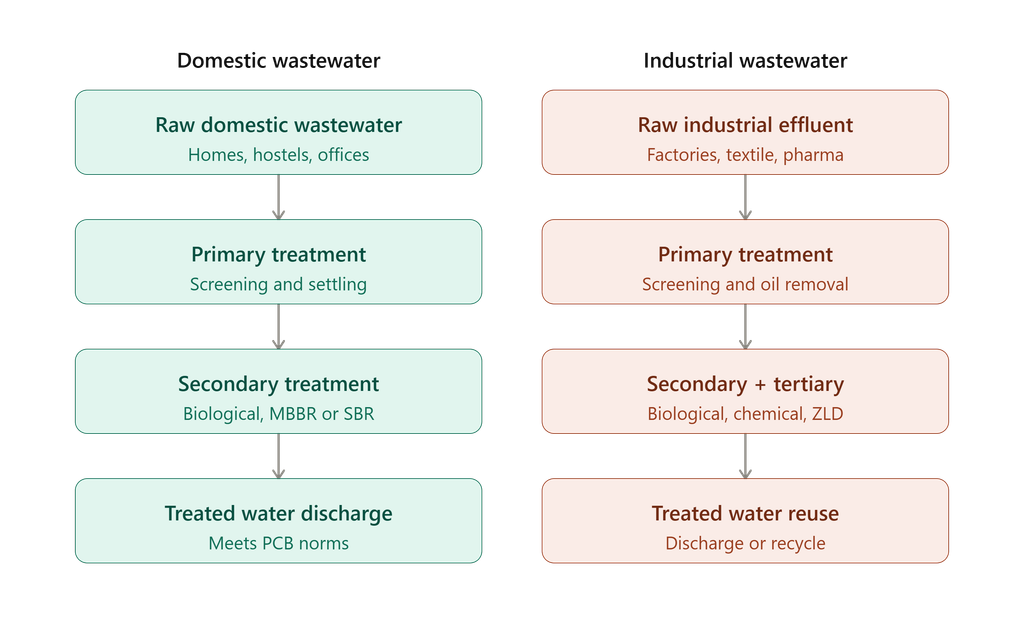
Domestic vs. Industrial Wastewater Treatment: Key Differences
Let’s put this side by side. Here’s a simple comparison table to help you understand the gap.
| Parameter | Domestic Wastewater | Industrial Wastewater |
|---|---|---|
| Source | Homes, hostels, offices, hotels | Factories, textile units, dairies, pharma plants |
| BOD Load | 150–300 mg/L (moderate) | 500–5000+ mg/L (varies widely by industry) |
| COD Load | 300–600 mg/L | 1000–10,000+ mg/L |
| Key Pollutants | Organic matter, pathogens, soap, nutrients | Heavy metals, oils, dyes, chemicals, solvents |
| Treatment Stages | Primary, secondary (biological) | Primary, secondary, and often tertiary/advanced treatment |
| Common Tech Used | STP-style ETP, MBBR, SBR | MBR, chemical dosing, ZLD systems |
| Regulatory Bodies | Local municipal norms + PCB | Strict CPCB + state PCB + sector-specific norms |
Simple takeaway: industrial wastewater usually needs stronger, multi-stage treatment. Domestic wastewater treatment is simpler, but still needs proper design to meet discharge norms.
How to Choose the Right ETP Water Treatment Plant
So, how do you actually pick the right plant? Here’s a practical checklist.
Step 1: Calculate Your Capacity Needs
Know your daily wastewater volume. Undersized plants overflow. Oversized plants waste money.
Step 2: Match the Technology to Your Waste Type
Popular ETP technologies include:
- SBR (Sequential Batch Reactor) – Good for variable flow, compact footprint.
- MBBR (Moving Bed Biofilm Reactor) – Handles higher loads, easy to upgrade.
- MBR (Membrane Bioreactor) – Best for high-quality reuse water, common in industrial setups.
- ZLD (Zero Liquid Discharge) – Needed for industries with strict “no discharge” norms.
Step 3: Factor in Cost, Not Just Price
Look at capital cost, but also running cost, chemical use, and sludge disposal. A cheaper plant today can cost you more every month.
Step 4: Check Footprint and Land Availability
Urban sites need compact designs. Industrial parks may have more room for bigger, multi-stage systems.
Step 5: Plan for Growth
Ask your consultant to design with future expansion in mind. This saves you a full plant redesign later.
Signs You Need to Consult an ETP Expert Right Now
Not sure if it’s time to call a consultant? Watch for these red flags:
- You received a non-compliance notice from the pollution control board.
- Your existing plant fails effluent quality tests repeatedly.
- You’re planning an expansion and your current ETP won’t handle the extra load.
- Your industry now requires Zero Liquid Discharge (ZLD) compliance.
- Your operating costs keep rising with no clear reason.
If any of this sounds familiar, don’t wait. Delayed action often means bigger fines and longer downtime later.
Real Results: How ERA Hydro-Biotech Solved a Client’s Compliance Challenge
One of our industrial clients faced repeated non-compliance notices due to high COD levels in their discharge. Our team ran a full site assessment, redesigned their treatment stages, and added an advanced biological treatment step.
Result: the client passed every compliance audit after that, cut their sludge disposal cost, and avoided plant shutdown risk completely.
This is the kind of hands-on, real-world experience ERA Hydro-Biotech Energy brings to every project. We don’t just design plants. We solve problems.
Explore our full ETP and ZLD solutions to see how we can help your site.
Frequently Asked Questions
What is the cost of setting up an ETP in India?
Cost depends on capacity, technology, and waste type. A small domestic ETP can start in the lakhs, while large industrial or ZLD plants can run into crores. Get a free site assessment for an accurate quote.
Is ETP mandatory for small industries?
Yes, in most cases. Even small units generating wastewater need CPCB or state PCB approval, and that usually means an ETP is mandatory.
How long does ETP consultancy take, from design to plant handover?
It typically takes a few weeks for design and approval, and a few months for construction and commissioning. Timelines vary based on plant size and site conditions.
What is the difference between ETP and STP?
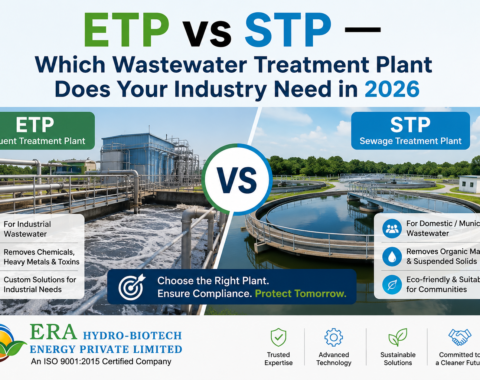
ETP (Effluent Treatment Plant) treats industrial wastewater. STP (Sewage Treatment Plant) treats domestic sewage. Some sites need both.
Can domestic and industrial wastewater be treated in the same plant?
Sometimes, yes, if the plant is designed for combined treatment. But this needs careful engineering to avoid overloading the biological treatment stage.
Conclusion
Choosing the right effluent treatment plant consultant protects your business, your compliance record, and your environment. Whether you run a residential project or a large industrial unit, the right plan starts with the right expert.
Talk to ERA Hydro-Biotech Energy today. Our team brings hands-on experience in ETP design, ZLD systems, and full regulatory compliance support, for both domestic and industrial wastewater treatment.