Water quality directly affects product quality, equipment life, and production efficiency. Yet, many industries struggle to choose between an RO plant and an industrial water treatment plant. While both improve water quality, they serve different purposes.
If you are planning a new project or upgrading your facility, understanding the difference can help you make the right investment.
At ERA Hydro-Biotech, we help industries select customized water treatment solutions that improve efficiency, reduce operating costs, and support Pollution Control Board (PCB) compliance.
Quick Answer
If your goal is to remove dissolved salts and produce high-purity water, choose an RO plant.
If your goal is to treat raw water by removing suspended solids, bacteria, iron, hardness, turbidity, or other impurities for industrial use, choose an industrial water treatment plant.
Many industries actually use both systems together for the best results.
What Is an RO Plant?
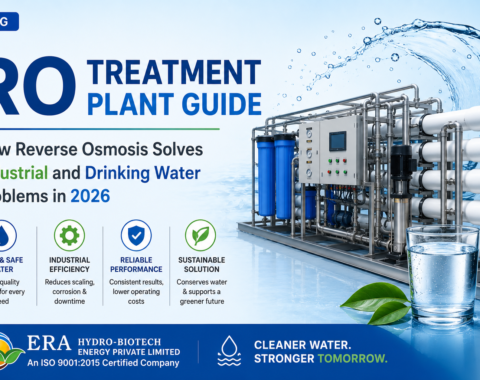
A Reverse Osmosis (RO) plant uses a semi-permeable membrane to remove dissolved salts, minerals, heavy metals, bacteria, viruses, and other contaminants from water.
It produces high-quality water suitable for applications that require low Total Dissolved Solids (TDS).
RO Plant Applications
- Pharmaceutical industries
- Food and beverage plants
- Electronics manufacturing
- Boiler feed water
- Laboratories
- Drinking water systems
Advantages
- Produces high-purity water
- Removes dissolved salts
- Improves product quality
- Protects sensitive equipment
- Reduces scaling
Limitations
- Does not replace complete water treatment.
- Requires pre-treatment.
- Generates reject water.
- Membranes need regular maintenance.
What Is an Industrial Water Treatment Plant?
An industrial water treatment plant is a complete system that treats raw water according to the industry’s requirements. It may include several treatment stages before supplying water for production or utilities.
Unlike an RO plant, it focuses on overall water conditioning rather than only removing dissolved salts.
Common Treatment Processes
- Raw water screening
- Aeration
- Coagulation
- Flocculation
- Clarification
- Sand filtration
- Activated carbon filtration
- Softening
- Iron removal
- UV disinfection
- RO treatment (if required)
The exact treatment process depends on the source water and the intended application.
RO Plant vs Water Treatment Plant: Key Differences
| Feature | RO Plant | Industrial Water Treatment Plant |
|---|---|---|
| Primary Purpose | Removes dissolved salts | Treats raw water comprehensively |
| Water Quality | High-purity water | Application-specific water quality |
| Technology | Reverse Osmosis Membrane | Multiple treatment technologies |
| TDS Removal | Excellent | Depends on system design |
| Hardness Removal | Yes | Yes (with suitable treatment) |
| Suspended Solids Removal | Limited (requires pre-treatment) | Yes |
| Water Source | Pre-treated water | Groundwater, river water, municipal water |
| Best For | High-purity applications | General industrial water treatment |
| Customization | Limited | Highly customizable |
Which Industries Need an RO Plant?
An RO plant works best for industries that require very low TDS water.
These include:
- Pharmaceutical manufacturing
- Food processing
- Beverage production
- Chemical industries
- Electronics manufacturing
- Healthcare facilities
- Laboratories
Which Industries Need an Industrial Water Treatment Plant?
An industrial water treatment plant is suitable for industries that require treated process water, utility water, or recycled water.
Industries include:
- Textile manufacturing
- Automobile industries
- Engineering industries
- Hotels
- Hospitals
- Educational institutions
- Commercial buildings
- Power plants
- Manufacturing industries
Can You Use Both Systems Together?
Yes.
Many industries combine an industrial water treatment plant with an RO system.
The water treatment plant removes large impurities, suspended particles, and hardness. The RO system then removes dissolved salts to produce high-quality water.
This combination increases membrane life and improves overall efficiency.
How to Choose the Right Solution
Before investing, consider the following factors.
1. Water Source
Is your water coming from:
- Borewell
- River
- Municipal supply
- Surface water
Each source requires a different treatment approach.
2. Water Quality
Test your water for:
- TDS
- Hardness
- Iron
- Turbidity
- pH
- Bacteria
- Chlorides
A water analysis helps determine the right system.
3. End Use
Ask yourself:
- Do you need drinking water?
- Is the water for production?
- Is it for boiler feed?
- Is it for cooling towers?
- Is it for process equipment?
The application decides the treatment technology.
4. Daily Water Requirement
Calculate your daily water consumption before selecting system capacity.
An oversized system increases costs, while an undersized system reduces efficiency.
5. Future Expansion
Choose a system that supports future production growth.
A modular design makes expansion easier.
Benefits of Choosing the Right Water Treatment Solution
The right system helps your business:
- Improve water quality
- Reduce maintenance costs
- Increase equipment life
- Lower operating expenses
- Save water
- Improve production efficiency
- Support sustainability goals
- Meet Pollution Control Board requirements
Why Work with a Professional Water Treatment Plant Company?
Choosing an experienced water treatment plant company offers several advantages.
A trusted company will:
- Study your water quality
- Design a customized solution
- Select the right technology
- Install and commission the plant
- Provide operator training
- Offer AMC and maintenance support
- Upgrade existing systems when needed
Working with an experienced water treatment plant company also reduces operational risks and improves long-term performance.
Why Industries Choose ERA Hydro-Biotech
ERA Hydro-Biotech has been delivering customized water and wastewater treatment solutions since 2006.
We design and install:
- Industrial Water Treatment Plants
- Sewage Treatment Plants (STP)
- Effluent Treatment Plants (ETP)
- Rainwater Harvesting Systems
- Biogas Plants
- Water Recycling Systems
- Plant Upgradation and Retrofitting
- Annual Maintenance Contracts (AMC)
Our experienced engineering team studies your water quality and operational requirements before recommending the most suitable solution.
Every project focuses on:
- Reliable performance
- Water conservation
- Low operating cost
- PCB compliance
- Sustainable operation
Whether you need a standalone RO plant or a complete industrial water treatment plant, we deliver solutions that match your business goals.
Frequently Asked Questions
Is an RO plant the same as a water treatment plant?
No. An RO plant removes dissolved salts using reverse osmosis membranes. An industrial water treatment plant uses multiple treatment processes to improve overall water quality.
Which is better for industries?
It depends on your application. Industries requiring high-purity water usually need an RO plant. Industries requiring general process water often need an industrial water treatment plant.
Can an industrial water treatment plant include an RO system?
Yes. Many customized treatment plants include RO as one stage of the complete treatment process.
How do I know which system my industry needs?
A professional water treatment plant company will analyze your water quality, production process, and daily water demand before recommending the best solution.
Can treated water be reused?
Yes. Many industries reuse treated water for cooling towers, gardening, flushing, washing, and process applications, helping reduce freshwater consumption.
Conclusion
Choosing between an RO plant and an industrial water treatment plant depends on your water source, water quality, and operational requirements.
An RO plant is ideal when you need low-TDS, high-purity water. An industrial water treatment plant provides complete treatment for a wide range of industrial applications and can also include an RO system when needed.
If you are unsure which solution is right for your facility, consult an experienced water treatment plant company like ERA Hydro-Biotech. Our experts evaluate your requirements and recommend a customized system that delivers reliable performance, long-term savings, and regulatory compliance.